 Unit Study
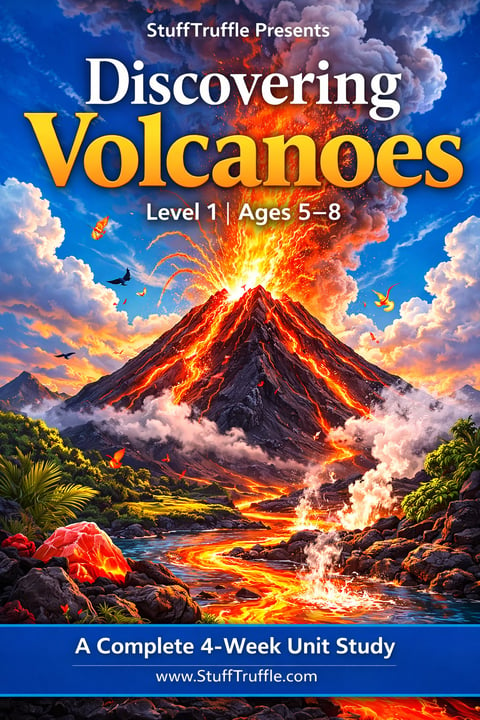
The Discovering Volcanoes Unit Study is a hands-on homeschool curriculum designed for children ages 5–8. This engaging 4-week unit study helps kids explore volcanoes through reading, math, and creative activities. Perfect for parents looking for a structured yet flexible way to teach through unit studies, this printable curriculum makes learning fun and meaningful.
Complete Unit Study
$79
Instant PDF Download • 40+ Printable Pages • Ages 5–8 • Certificate of completion included
🔒 Secure checkout via Gumroad • Instant download
StuffTruffle unit studies are thoughtfully designed homeschool curriculum resources that help children explore fascinating topics while building real academic skills across multiple subjects. Each 4-week printable unit study includes:
Guided daily activities for consistent progress
Cross-curricular activities for well-rounded education
Sorting, matching, and creative design activities
Comprehension passages and problem-solving exercises
Just print and go — no complicated prep needed
Celebrate your child's achievements!
Perfect for homeschool families, co-ops, and curious learners ages 5–8.
Learn new words related to volcanoes and earth science
Develop early reading skills with engaging passages
Strengthen counting and number sense through volcano-themed activities
Practice sequencing and problem-solving skills
Fascinating facts about volcanoes and the Earth
Express what they know through drawing, writing, and creative design
Counting, patterns, and number recognition through volcano themes
Comprehension passages and creative writing exercises
Interactive activities to reinforce learning concepts
Art and design projects inspired by volcanic eruptions
Fun volcano-themed game for the whole family to enjoy
Celebrate finishing the unit with a special certificate
Level 1 | Ages 5–8 | 40+ Pages
$79
Instant Digital Download
🔒 Secure checkout via Gumroad • Instant download
Discovering Volcanoes takes young learners on a journey to the most powerful and dramatic geological forces on Earth — mountains that breathe fire, landscapes reshaped overnight, and eruptions so massive they have changed the course of human history and altered the climate of the entire planet. Over four weeks, children aged 5–8 explore the science, geography, and human story of volcanoes through hands-on activities, creative projects, and rich informational content that transforms what might seem like a distant and abstract natural phenomenon into something vivid, immediate, and genuinely thrilling. From the buried streets of Pompeii to the lava fields of Hawaii to the underwater volcanoes quietly building new islands on the floor of the Pacific Ocean — this unit reveals volcanoes not as isolated disasters but as fundamental forces that have shaped the world we live in.
The geology and science of volcanoes form the scientific core of the unit. Children explore the structure of the Earth from the inner core outward, learning how the movement of tectonic plates creates the conditions for volcanic activity at boundaries and hotspots around the world. A volcano types sorting activity introduces the three main categories — shield volcanoes, composite volcanoes, and cinder cone volcanoes — helping children understand how the composition of magma determines everything from the shape of a volcano to the violence of its eruption. A detailed body parts matching activity covers the anatomy of a volcano from magma chamber to vent to crater to lava flow, while a measurement activity brings the extraordinary scale of real volcanoes to life — comparing the height of Mauna Loa, the width of Yellowstone's caldera, and the reach of a pyroclastic flow in ways that make these geological giants feel genuinely immense. A sequencing activity walks children through the stages of a volcanic eruption step by step, from the first rumblings of seismic activity deep below the surface to the cooling of lava flows and the gradual return of life to the surrounding landscape.
Geography and the global distribution of volcanoes run through the unit from beginning to end. Children learn about the Ring of Fire — the horseshoe-shaped zone of intense volcanic and seismic activity encircling the Pacific Ocean where the majority of the world's active volcanoes are found — and discover that volcanoes are not randomly scattered across the Earth but are concentrated along the boundaries of tectonic plates and above deep mantle hotspots. A famous volcanoes region sorting activity places iconic volcanoes in their correct locations around the world, from Mount Etna in Sicily to Krakatoa in Indonesia to Popocatépetl in Mexico to the shield volcanoes of Iceland, building an early geographic awareness of how geological forces connect places that appear on the map as very far apart. Children also discover the surprising places where volcanic activity occurs — including beneath the ocean, beneath ice sheets, and on other planets in our solar system.
History and human experience give the unit an emotional depth that pure science cannot provide alone. A timeline activity traces the human story of volcanic discovery and disaster from the eruption of Vesuvius in 79 AD that buried Pompeii and Herculaneum, through the 1815 eruption of Mount Tambora that caused the infamous Year Without a Summer, through the development of modern volcanology as a scientific discipline, to the real-time monitoring systems that today give scientists the ability to predict eruptions and save lives. A cause and effect reading activity in Week 4 explores the dual nature of volcanoes — the destruction they cause and the extraordinary gifts they leave behind, from the impossibly fertile volcanic soils that have fed civilizations for millennia to the new land they create from nothing to the role volcanic gases have played in shaping Earth's atmosphere over geological time.
Math and literacy skills are built into every week. Children practice counting and number recognition through the Roll & Cover Eruption Numbers game, identify nouns in a richly detailed geological reading passage set at an active volcano research station, solve addition word problems in a volcanology and emergency response context, and read and interpret a bar graph of volcano facts. The Volcano Movement Math Lab brings the energy and drama of an eruption into the classroom — children roll a die and complete a series of eruption-themed movements, from rumbling tremors to lava flows to ash clouds, combining physical activity with number practice in a way that captures the unit's spirit of wonder and excitement perfectly. The unit closes with the Don't Get Buried! board game and a culminating showcase presentation where children share their favorite volcano discoveries and demonstrate everything they have learned about the fiery forces that have been building and destroying and rebuilding our world since long before the first human being ever walked upon it.
Use your education funds to purchase Stuff Truffle unit studies.
4-week structured curriculum
Hands-on, cross-curricular learning
Designed for ages 5–8 (K–3)
Instant digital download
This unit study is perfect for children ages 5-8, but can be easily adapted for older or younger learners depending on their reading level and interest.
No! Everything you need is included in the PDF download. You may want to have basic supplies like crayons, pencils, dice, scissors, and paper on hand for the hands-on activities.
Most families complete the unit study over 3-4 weeks, spending about 20-30 minutes per day. You can go at your own pace and extend or compress as needed.
Yes! Our unit studies are designed with neurodiverse learners in mind, featuring clear instructions, visual supports, and flexible activity options.
Volcanoes — $79 — Instant Digital Download
Get This Unit Study🔒 Secure checkout via Gumroad • Instant download
Many families enjoy completing several Stuff Truffle units throughout the year as their child explores new interests.