Home › Unit Studies › Axolotls
← Back to All Unit Studies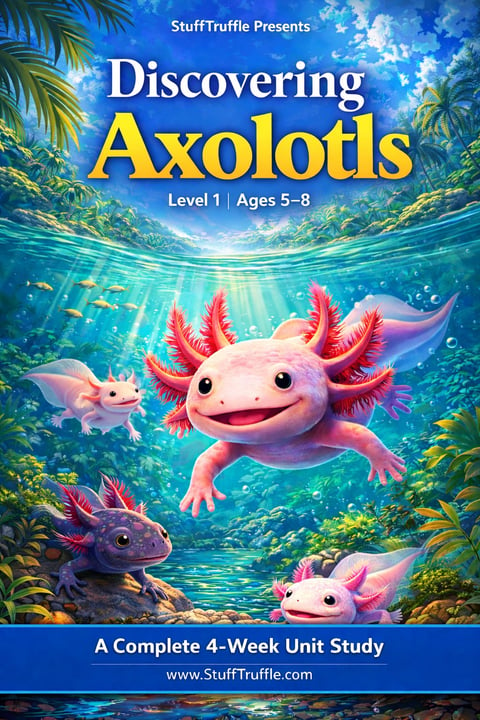
The Discovering Axolotls Unit Study is a hands-on homeschool curriculum designed for children ages 5–8. This engaging 4-week unit study helps kids explore axolotls through reading, math, and creative activities. Perfect for parents looking for a structured yet flexible way to teach through unit studies, this printable curriculum makes learning fun and meaningful.
Complete Unit Study
$79
Instant PDF Download • 40+ Printable Pages • Ages 5–8 • Certificate of completion included
🔒 Secure checkout via Gumroad • Instant download
StuffTruffle unit studies are thoughtfully designed homeschool curriculum resources that help children explore fascinating topics while building real academic skills across multiple subjects. Each 4-week printable unit study includes:
4 weeks of structured, guided learning
Reading, writing, math, and science activities
Hands-on sorting, matching, and creative design projects
Vocabulary building, comprehension passages, and critical thinking
Low-prep printable worksheets — just print and go
A colorful certificate of completion
Perfect for homeschool families, co-ops, and curious learners ages 5–8.
Learn new words related to axolotls
Develop early reading skills
Strengthen counting and number sense
Practice sequencing and problem-solving
Fascinating facts about axolotls and the world around them
How to express what they know through drawing, writing and creative design
Discovering Axolotls
Level 1 | Ages 5–8 | 40+ Pages
$79
Instant Digital Download
🔒 Secure checkout via Gumroad • Instant download
Discovering Axolotls introduces young learners to one of the most fascinating and unusual creatures on Earth — an animal that never fully grows up, can regrow lost limbs, gills, and even parts of its heart and brain, and exists naturally in just one lake system in the entire world. Over four weeks, children aged 5–8 explore the extraordinary biology, cultural history, and conservation story of the axolotl through hands-on activities, creative projects, and rich informational content that makes this captivating animal feel like something from science fiction — except that every remarkable detail is entirely true. From the ancient Aztec legends that gave the axolotl its name, to the cutting-edge medical research inspired by its regenerative abilities, this unit opens a window onto a world of science that genuinely surprises and delights.
The biology of the axolotl is the scientific core of the unit. Children explore the concept of neoteny — the axolotl's extraordinary ability to reach adulthood and reproduce while retaining the physical features of a juvenile, including its spectacular feathery external gills. They sequence the axolotl's life cycle from egg to larva to mature adult, discovering how it differs fundamentally from the metamorphosis of a typical salamander. A detailed body parts matching activity introduces children to the axolotl's most remarkable features — the regenerative tissue that can rebuild lost limbs from scratch, the lateral line system that detects vibrations in the water, the lidless eyes that give the axolotl its perpetually wide-eyed expression, and the four stubby legs that make it look like it can't quite decide whether to be a fish or a lizard. A sorting activity compares the axolotl to the tiger salamander — its closest relative and the animal it would become if its metamorphosis were triggered — helping children understand what makes the axolotl genuinely unique among amphibians.
Habitat, conservation, and geography form another rich strand of the unit. Children learn that the axolotl exists naturally only in the lake system of Xochimilco on the outskirts of Mexico City — a habitat that has shrunk dramatically due to urban development, pollution, and the introduction of invasive species. A habitat zone sorting activity places the axolotl and its freshwater neighbors into the correct zones of a lake ecosystem, from open water to shallow margins to muddy banks to woodland edges. A cause and effect reading activity in Week 4 explores the pressures facing the axolotl in the wild — water pollution, habitat loss, predation by introduced carp and tilapia — while also celebrating the conservation programs, university research stations, and citizen breeding initiatives working to ensure this irreplaceable animal survives. A region sorting activity introduces children to real conservation institutions and research programs around the world that are working to protect the axolotl.
History and culture add a dimension rarely found in science units for young children. A timeline activity traces the axolotl's story from its place in Aztec mythology in the 1300s — where it was associated with the god Xolotl and believed to be a transformed deity — through its first scientific description by European naturalists in the 1860s, through its arrival in research laboratories around the world, to its current status as one of the most studied animals in regenerative medicine. Children discover that the axolotl's ability to regrow complex tissue is actively being researched by scientists hoping to unlock new treatments for human injuries and diseases — making this not just a story about a remarkable animal, but a story about the future of medicine.
Math and literacy skills are woven into every week. Children practice counting and number recognition through the Roll & Cover Lake Xochimilco Numbers game, identify nouns in a richly detailed reading passage set in a freshwater research station, solve addition word problems in a conservation context, and read and interpret a bar graph of axolotl facts. The Regrow It! movement lab brings the axolotl's most famous ability to life — children roll a die and complete a series of playful regeneration-themed movements, combining kinesthetic learning with number sense in a way that reinforces the unit's science content joyfully and memorably. The unit closes with the Regrow It! board game and a culminating showcase presentation where children share their favorite axolotl discoveries and reflect on why this small, smiling, feather-gilled creature from a single Mexican lake deserves to be known and protected by the whole world.
Use your education funds to purchase Stuff Truffle unit studies.
This unit study is perfect for children ages 5-8, but can be easily adapted for older or younger learners depending on their reading level and interest.
No! Everything you need is included in the PDF download. You may want to have basic supplies like crayons, pencils, dice, scissors, and paper on hand for the hands-on activities.
Most families complete the unit study over 3-4 weeks, spending about 20-30 minutes per day. You can go at your own pace and extend or compress as needed.
Yes! Our unit studies are designed with neurodiverse learners in mind, featuring clear instructions, visual supports, and flexible activity options.
Axolotls — $79 — Instant Digital Download
Get This Unit Study🔒 Secure checkout via Gumroad • Instant download
Many families enjoy completing several Stuff Truffle units throughout the year as their child explores new interests.