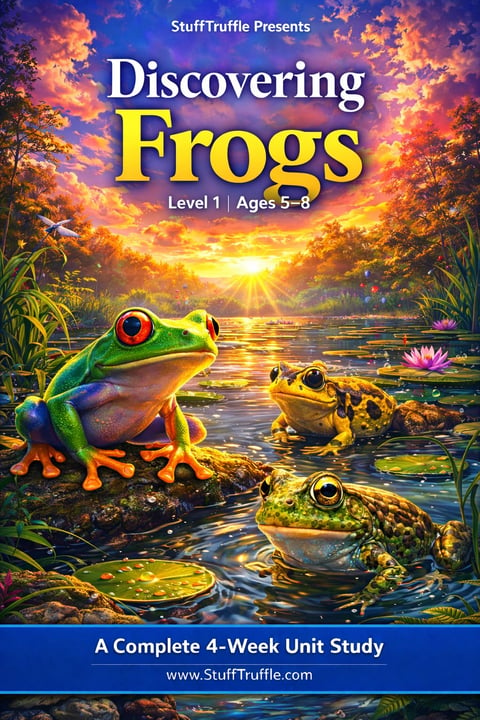
The Discovering Frogs Unit Study is a hands-on homeschool curriculum designed for children ages 5–8. This engaging 4-week unit study helps kids explore frogs through reading, math, and creative activities. Perfect for parents looking for a structured yet flexible way to teach through unit studies, this printable curriculum makes learning fun and meaningful.
🔒 Secure checkout via Gumroad • Instant download
StuffTruffle unit studies are thoughtfully designed homeschool curriculum resources that help children explore fascinating topics while building real academic skills across multiple subjects. Each 4-week printable unit study includes:
Perfect for homeschool families, co-ops, and curious learners ages 5–8.
Learn new words related to frogs
Develop early reading skills
Strengthen counting and number sense
Practice sequencing and problem-solving
Fascinating facts about frogs and the world around them
How to express what they know through drawing, writing and creative design
Counting, patterns, and simple math exercises
Comprehension passages and vocabulary building
Interactive learning games and activities
Art, coloring, and design activities
Fun learning game the whole family can enjoy
Celebrate learning milestones
Discovering Frogs
Level 1 | Ages 5–8 | 40+ Pages
Instant Digital Download
🔒 Secure checkout via Gumroad • Instant download
Discovering Frogs invites young learners into the surprising and captivating world of amphibians — creatures that have lived on Earth for over 360 million years, that survive on every continent except Antarctica, and that lead one of the most extraordinary double lives in the entire animal kingdom. Over four weeks, children aged 5–8 explore the biology, ecology, and conservation story of frogs through hands-on activities, creative projects, and rich informational content that transforms a familiar backyard creature into a source of genuine scientific wonder. From the glasswing-transparent skin of the glass frog revealing its beating heart, to the poison dart frog's brilliant warning colors, to the wood frog that survives being frozen solid through an entire Arctic winter — this unit reveals frogs as among the most diverse, adaptable, and fascinating animals on the planet.
The biology of frogs and the miracle of metamorphosis form the scientific heart of the unit. Children explore the complete transformation from egg to tadpole to froglet to adult in step-by-step detail — discovering that a tadpole's tail is not simply lost but absorbed back into the body as fuel for the transformation, that gills are replaced by lungs as the animal prepares for its first breath of air, and that the entire process is orchestrated by hormones triggered by environmental cues including temperature, light, and rainfall. A detailed body parts matching activity introduces children to the remarkable engineering of the frog's body — the tympanic membrane that detects sound vibrations, the sticky extendable tongue that strikes prey in under a tenth of a second, the toe pads that can cling to vertical glass, and the permeable skin through which frogs absorb both water and oxygen directly from their environment. A frog vs. toad sorting activity helps children understand the differences between two animals most people use interchangeably, exploring the distinctions in skin texture, leg length, egg-laying habits, and toxicity that separate them as distinct groups.
Wetland habitats, ecosystems, and the global distribution of frogs weave through the unit from beginning to end. Children sort wetland animals and plants into four habitat zones — from open water to shallow margins to muddy banks to woodland edges — discovering how different species of frog, fish, bird, and invertebrate occupy different niches within the same interconnected ecosystem. A famous frog habitats sorting activity places iconic frog species and locations in their correct regions around the world, from the poison dart frogs of the Amazon rainforest to the chorus frogs of the North American wetlands to the tree frogs of the Daintree rainforest in Australia to the bizarre and beautiful species found in the highland forests of Borneo. Children learn that frogs are not randomly distributed across the world but are concentrated in warm, wet environments where the standing water they need to breed is reliably available — and that their absence from a wetland is one of the clearest signs that something in that ecosystem has gone wrong.
Conservation and the future of frogs is one of the most compelling threads running through the unit. Frogs are among the most threatened groups of animals on Earth — nearly one third of all amphibian species are currently at risk of extinction — and the unit addresses this honestly and age-appropriately. A cause and effect reading activity introduces children to the pressures facing frog populations worldwide, including wetland drainage, agricultural pesticides, climate-driven changes to rainfall patterns, and the chytrid fungus — a waterborne pathogen that has driven dozens of frog species to extinction in recent decades and remains the single greatest infectious disease threat to vertebrate biodiversity ever recorded. The activity balances this sobering reality with genuine hope, exploring the captive breeding programs, wetland restoration projects, and disease management strategies that are giving threatened species a fighting chance.
History and human connection to frogs add richness and context throughout the unit. A timeline activity traces the human story of frog science from Aristotle's first written descriptions of amphibian life cycles in ancient Greece, through the 17th century microscopy that revealed the details of tadpole development for the first time, through the 19th century classification of amphibians as a distinct group separate from reptiles, to the discovery of the chytrid fungus in the 1990s and the global conservation response it triggered. Children discover that frogs have been subjects of scientific study, cultural symbolism, and human fascination across every civilization and every era — from the frog hieroglyphs of ancient Egypt to the frog princes of European fairy tales to the laboratory frogs that helped scientists understand the fundamental mechanisms of nerve and muscle function.
Math and literacy skills are embedded into every week. Children practice counting and number recognition through the Roll & Cover Pond Numbers game, identify nouns in a richly detailed wetland reading passage featuring a scientist observing frogs at dawn, solve addition word problems set in a wildlife center and conservation release context, and read and interpret a bar graph of frog facts. The Frog Movement Math Lab gets children leaping, croaking, freezing, and tongue-snapping their way through number practice — combining the boundless physical energy of young learners with genuine mathematical thinking in a way that captures the joyful spirit of the unit perfectly. The unit closes with the Leap Frog! board game and a culminating showcase presentation where children share their favorite frog discoveries, reflect on why these ancient and extraordinary animals matter, and make the case — with facts, confidence, and hard-won knowledge — for why the world's wetlands and the remarkable creatures that depend on them are worth fighting to protect.
Use your education funds to purchase Stuff Truffle unit studies.
This unit study is perfect for children ages 5-8, but can be easily adapted for older or younger learners depending on their reading level and interest.
No! Everything you need is included in the PDF download. You may want to have basic supplies like crayons, pencils, dice, scissors, and paper on hand for the hands-on activities.
Most families complete the unit study over 3-4 weeks, spending about 20-30 minutes per day. You can go at your own pace and extend or compress as needed.
Yes! Our unit studies are designed with neurodiverse learners in mind, featuring clear instructions, visual supports, and flexible activity options.
Frogs — $79 — Instant Digital Download
🔒 Secure checkout via Gumroad • Instant download
Many families enjoy completing several Stuff Truffle units throughout the year as their child explores new interests.