Home › Unit Studies › Community Helpers
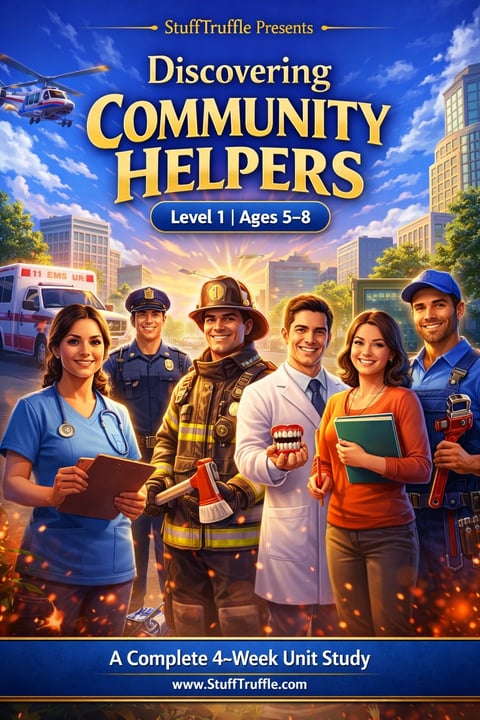
The Discovering Community Helpers Unit Study is a hands-on homeschool curriculum designed for children ages 5–8. This engaging 4-week unit study helps kids explore community helpers through reading, math, and creative activities. Perfect for parents looking for a structured yet flexible way to teach through unit studies, this printable curriculum makes learning fun and meaningful.
Instant PDF Download • 40+ Printable Pages • Ages 5–8 • Certificate of completion included
🔒 Secure checkout via Gumroad • Instant download
StuffTruffle unit studies are thoughtfully designed homeschool curriculum resources that help children explore fascinating topics while building real academic skills across multiple subjects. Each 4-week printable unit study includes:
Guided daily activities for consistent progress
Cross-curricular activities for well-rounded learning
Sorting, matching, and creative design activities
Comprehension passages and critical thinking exercises
Just print and go — no complicated prep needed
Celebrate your child's achievement with a printable certificate
Perfect for homeschool families, co-ops, and curious learners ages 5–8.
Learn new words related to community helpers and the important work they do in our neighborhoods.
Develop early reading skills with engaging passages about the people who help us every day.
Strengthen counting, number sense, and basic math concepts through community helper-themed activities.
Practice sequencing, pattern recognition, and problem-solving through hands-on activities.
Fascinating facts about community helpers and the world around them
How to express what they know through drawing, writing and creative design
Counting, sorting, and number recognition through community helper-themed exercises
Vocabulary building, trace-and-learn, and early writing practice
Interactive cut-and-paste activities to reinforce learning
Coloring pages, drawing activities, and imaginative art projects
A fun community helpers board game the whole family can enjoy
Celebrate finishing the unit with a special certificate
Discovering Community Helpers
Level 1 | Ages 5–8 | 40+ Pages
$79
Instant Digital Download
🔒 Secure checkout via Gumroad • Instant download
Discovering Community Helpers is a four-week printable unit study designed for children aged 5–8. It introduces young learners to the many different people who work together to keep our communities safe, healthy, educated, and functioning every day — exploring who community helpers are, what they do, the tools they use, and how their roles have changed throughout history. Activities build skills across social studies, reading, math, and creative arts.
Week 1 lays the foundation, introducing children to a wide range of community helper roles and the different types of service they provide. Children sort ten helper cards into four categories — safety and emergency, health and wellbeing, education and learning, and building and infrastructure — practice helper vocabulary through bingo, color a noun-finding reading activity set in a busy community street, and create their own community helper fact card. Week 2 goes deeper, with students sequencing the six stages of a firefighter's shift from morning handover to post-incident debrief, placing key moments in the history of community helping on a timeline from ancient physicians to today's digital helpers, matching eight community helpers to detailed descriptions of their most important tools, and measuring and comparing real helper tools from a stethoscope head to an aerial fire truck ladder.
Week 3 takes the learning wider, exploring how helpers serve different types of communities — hospitals, schools, local towns, and rural and remote areas. Students sort ten helper cards into their correct community setting, read and answer questions about the people who keep us safe, interpret a bar graph of community helper facts, and get moving with the On Duty! movement math lab where they sprint like a firefighter, walk like a postal worker, and carry like a paramedic. Week 4 brings everything together, with word problems set in the world of community helping, a cause and effect reading activity tracing how the work of helpers like Dr John Snow and Florence Nightingale changed entire communities, a sorting activity featuring eight famous helpers from history including Hippocrates, Harriet Tubman, Nelson Mandela, and Malala Yousafzai, and a board game that reviews the full unit.
The unit closes with a creative design activity in Week 3 — where students design their own imaginary community helper role, including job title, uniform, tools, training, and a written explanation of the problem their helper solves — and a showcase presentation in Week 4 where they share everything they have learned. Every activity includes Make It Easier and Make It Harder options, making the unit flexible for a wide range of learners. The unit ends with a completion certificate.
Use your education funds to purchase Stuff Truffle unit studies.
This unit study is perfect for children ages 5-8, but can be easily adapted for older or younger learners depending on their reading level and interest.
No! Everything you need is included in the PDF download. You may want to have basic supplies like crayons, pencils, dice, scissors, and paper on hand for the hands-on activities.
Most families complete the unit study over 3-4 weeks, spending about 20-30 minutes per day. You can go at your own pace and extend or compress as needed.
Yes! Our unit studies are designed with neurodiverse learners in mind, featuring clear instructions, visual supports, and flexible activity options.
Community Helpers — $79 — Instant Digital Download
Get This Unit Study🔒 Secure checkout via Gumroad • Instant download
Many families enjoy completing several Stuff Truffle units throughout the year as their child explores new interests.