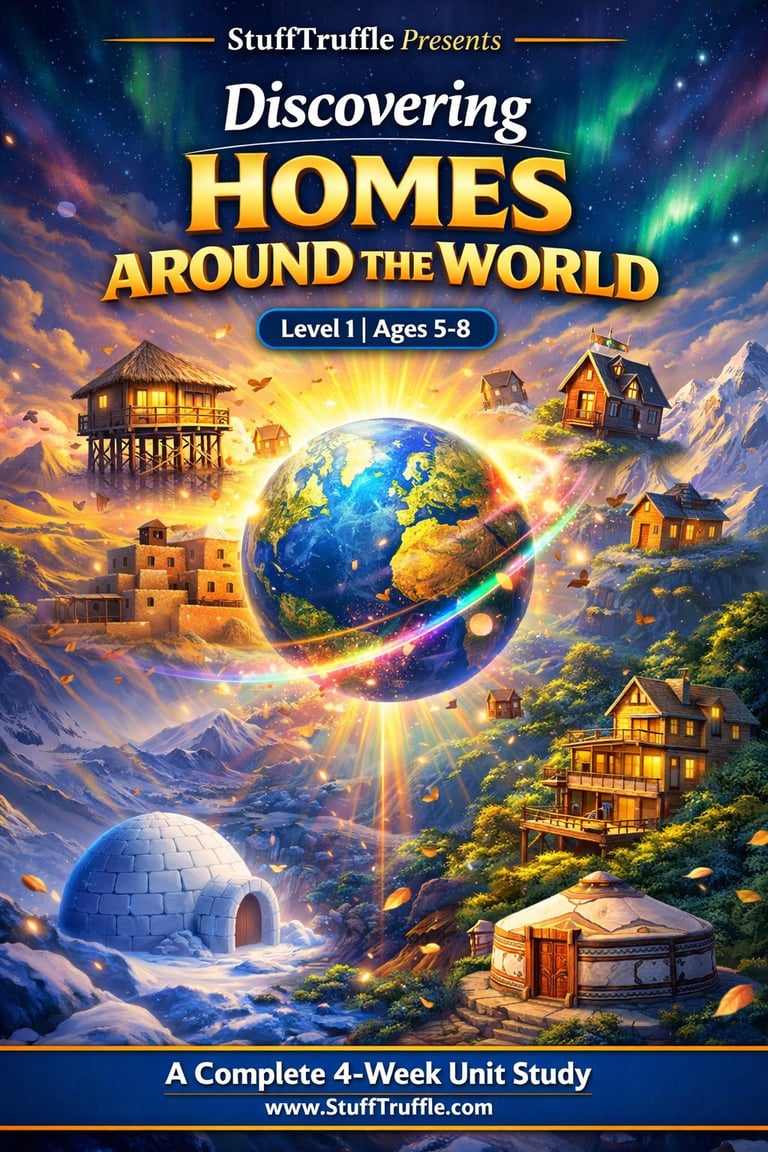
The Discovering Homes Around the World Unit Study is a hands-on homeschool curriculum designed for children ages 5–8. This engaging 4-week unit study helps kids explore homes around the world through reading, math, and creative activities. Perfect for parents looking for a structured yet flexible way to teach through unit studies, this printable curriculum makes learning fun and meaningful.
Instant PDF Download • 40+ Printable Pages • Ages 5–8 • Certificate of completion included
🔒 Secure checkout via Gumroad • Instant download
StuffTruffle unit studies are thoughtfully designed homeschool curriculum resources that help children explore fascinating topics while building real academic skills across multiple subjects. Each 4-week printable unit study includes:
4 weeks of structured, guided learning
Reading, writing, math, and science activities
Hands-on sorting, matching, and creative design projects
Vocabulary building, comprehension passages, and critical thinking
Low-prep printable worksheets — just print and go
A colorful certificate of completion
Perfect for homeschool families, co-ops, and curious learners ages 5–8.
Learn new words related to homes around the world
Develop early reading skills
Strengthen counting and number sense
Practice sequencing and problem-solving
Fascinating facts about homes around the world and the world around them
How to express what they know through drawing, writing and creative design
Discovering Homes Around the World
Level 1 | Ages 5–8 | 40+ Pages
$79
Instant Digital Download
🔒 Secure checkout via Gumroad • Instant download
Discovering Homes Around the World is a complete four-week unit study designed for children ages 5–8. It takes young learners on a journey across every continent, exploring the extraordinary variety of ways that human beings have built shelter throughout history and around the globe today. From the snow-block dome of an Arctic igloo to the felt-covered yurt of a Mongolian nomad, from the mud-brick adobe pueblos of the American Southwest to the bamboo stilt houses of Southeast Asia, children discover that every home tells a story about the place it was built and the people who live inside it.
The unit is built around a single powerful idea: that the climate, materials, and culture of a place shape the way people build. Children learn why thick adobe walls act as a natural thermostat in the desert, why stilt houses keep families dry during monsoon floods, and why the dome shape of an igloo can stay warm at minus 40 degrees. This connection between environment and design runs through every week of the unit, giving children a framework for understanding not just the homes in the unit but any home they encounter in the wider world.
Across four weeks, children engage with the topic through a wide variety of activities including vocabulary bingo, a compare and contrast chart, a homes through history timeline, a memory-style matching game, reading comprehension passages, a bar graph, sorting activities, a movement math lab, a creative design activity, a board game, and a culminating showcase presentation. Every activity covers real academic skills — reading, writing, addition, graph reading, sequencing, and critical thinking — while keeping the focus on the endlessly fascinating subject of how people around the world call a place home.
Use your education funds to purchase Stuff Truffle unit studies.
This unit study is perfect for children ages 5-8, but can be easily adapted for older or younger learners depending on their reading level and interest.
No! Everything you need is included in the PDF download. You may want to have basic supplies like crayons, pencils, dice, scissors, and paper on hand for the hands-on activities.
Most families complete the unit study over 3-4 weeks, spending about 20-30 minutes per day. You can go at your own pace and extend or compress as needed.
Yes! Our unit studies are designed with neurodiverse learners in mind, featuring clear instructions, visual supports, and flexible activity options.
Discovering Homes Around the World — $79 — Instant Digital Download
Get This Unit Study🔒 Secure checkout via Gumroad • Instant download
Many families enjoy completing several Stuff Truffle units throughout the year as their child explores new interests.